Ryan Leslie - "Breathe" World Premiere (Live in SF)
Publicado March 4, 2011
Category:
Music
0
comentarii


Little 9-10 Year Old Girls (Watoto From The Nile) Get At Lil Wayne For His Violent, Drug Fueled, Misogynistic Lyrics In Their Song "Letter To Lil Wayne"
Publicado
Not everyone hangs on Lil Wayne's every lyric, thinking he is the best rapper ever.
Watoto From The Nile's song "Letter to Lil Wayne" is deep and moving.
Written and rapped from the perspective of little girls. The song talks about the confusion felt by children when they hear stars like Weezy say things that go against what they are taught at home and in school.
"Letter to Lil Wayne" is a direct statement of justice from Watoto From The Nile. Growing tired and fed up with the constant degredation of Black women inside of Hip Hop music, they voice thier views and opinions on this melodic track.
Source: ThisIs50
Category:
Education,
Music
0
comentarii
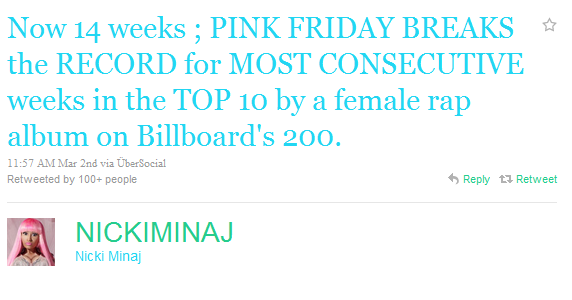
Nicki Minaj Sets Record: 'Pink Friday' Album Is 1st Female Rap Album To Hold Top 10 Spot For 14 Consecutive Weeks On Billboard 200 Chart
Publicado

It now claims the record for most consecutive weeks in the top ten by a female rap album in Billboard album chart with fourteen and counting.
Of course Nicki was more than happy to tweet the good news to her followers.
Source: ThisIs50
Category:
Music
0
comentarii
2011 Geneva Auto Show
Publicado
GENEVA -- The air at the 2011 Geneva Motor Show was ... ahem ... electric (with concept cars, that is). From the bottom of the spectrum with the new Toyota Yaris hybrid, all the way to the top with the purely electric Rolls-Royce Phantom-based 102EX, not since the 1881 Exhibition of Electricity in Paris, which congregated electric technologists from all over the world, has so much wattage been on display.
And yet, it wasn't just the electrically powered machines that had the crowd buzzing. Alternative fuels and unconventional propulsion systems have apparently taken deep root in the world's automotive labs. A four-wheel-drive Ferrari? Did you think you'd live to see the day? And who could have imagined a BMW that talks to inanimate objects?
Geneva Showstoppers:
1.Rolls Royce 102EX concept

2. Volkswagen Bulli Microbus concept

3. Nissan Esflow electric concept

4. Smart Forspeed concept

5. Ferrari FF

6. BMW Vision ConnectDrive Roadster concept

7. Alfa Romeo 4C GTA

8. Mini Rocketman concept

9. Toyota FT-86 II sports coupe

10. Lamborghini Aventador

11. Saab PhoeniX concept

12. Toyota Yaris HSD concept

Source: Yahoo
Category:
Auto - Moto
0
comentarii
Megan Fox for Emporio Armani Underwear and Armani Jeans Spring/Summer 2011 advertising campaign.
Publicado March 3, 2011
Category:
Celebrities,
Fashion
0
comentarii
The most typical face on the planet
Publicado

The researchers conclude that a male, 28-year-old Han Chinese man is the most typical person on the planet. There are 9 million of them.
The image above is a composite of nearly 200,000 photos of men who fit that description.
Don't get used to the results, however. Within 20 years, the most typical person will reside in India.
Category:
Education,
Science,
World
0
comentarii
WikiLeaks: How the Cola war was won in Libya
Publicado

The contretemps among the freres Gaddafi over a local bottling plant escalated into a heavily armed confrontation resembling a Hollywood gangster film, as a classified 2006 U.S. cable put it.
"You know the movie 'The Godfather'? We've been living it for the last few months," a businessman involved in the dispute was quoted in the cable as telling an official from the U.S. diplomatic mission in Tripoli.
The cable, which was made available to Reuters by a third party, centers on a bottling plant in Tripoli that was shut down for three months. It had been seized by troops loyal to Mutassim Gaddafi, a son of Muammar, who at the time was feuding with one of his brothers, Mohammed. (Another State Department cable suggests a third Gaddafi son, Saadi -- better known as the family's professional soccer player -- may also have been involved in the squabble, though no details of his role are given.)
Eventually, the American diplomatic mission in Tripoli, known then as the U.S. Liaison Office, sent a firm protest to the Libyan government. The document states that around the same time, Mohammed Gaddafi, possibly under pressure from his sister Aisha, a family peacemaker, apparently agreed that shares owned by the Libyan Olympic Committee, which he led, would be sold to a third party.
Shortly afterward, the cable says, Mutassim's men left the Coke plant, ending the family standoff, but not before employees of the plant received threats of bodily harm and a Gaddafi cousin was stuffed in the trunk of a car.
U.S. FREEZES FAMILY ASSETS
The Coca-Cola confrontation is among numerous tales about endless squabbling within the Gaddafi clan recounted in State Department cables. Among other things, the incident underlines the difficulties faced by foreign companies operating in Libya even after the U.S. and United Nations began to scale back sanctions following Muammar Gaddafi's decision in late 2003 to abandon his nuclear weapons program.
A spokesman for Coca-Cola acknowledged there had been "some uncertainty" surrounding Coke distribution arrangements in Libya during the period described in the cable. But the problem was "resolved amicably" by the end of 2006, the spokesman said, and since then, Coca-Cola had been operating normally in Libya until the onset of the current unrest.
A spokesman for the State Department said: "We will decline to comment on any particular cable. The U.S. has taken aggressive action in recent days to freeze the assets of the Qaddafi family. Thus far, more than $30 billion in assets have been blocked."
WORKERS THREATENED, PLANT MATERIALS DESTROYED
Back when Libya was isolated by economic sanctions, its Coca-Cola supply was limited to consignments of the beverage bottled at a plant in Tunisia and transported to Tripoli and Benghazi.
After U.S. and international trade embargoes on Libya began to ease, the Tripoli plant was established. It was co-owned by what the cable describes as a British company called Ka'Mur -- whose name was a reference to two embargo-era Libyan soft-drinks -- and by the Libyan Olympic Committee, headed by Mohammed Gaddafi.
Immediately after this joint venture was set up, the State Department cable says, the embargo-era Libyan distributor of bottled Coke sued the group behind the newly-opened plant, alleging breach of contract. A complaint was also sent to Coca Cola International alleging that the bottling plant operators had "stolen the franchise" from the previous distributors, according to the cable. The bottling plant operators counter-sued.
Then, on December 28, 2005 -- two weeks after the Tripoli plant began turning out locally-bottled batches of Coke -- "two military cars carrying armed personnel without clear identification illegally broke into the facility, asked the employees to leave the premises and shut down the plant," according to an account of the incident a businessman gave to U.S. diplomats.
The U.S. mission in Libya learned from other sources that the troops were loyal to Mutassim Gaddafi, who, after the Coca-Cola dispute was resolved, was named Libya's national security adviser.
According to the State Department cable, Mutassim bore a grudge against his brother because he had "taken over" the embargo-era domestic soft-drink business in the late 1990s when Mutassim had been exiled to Egypt for "insubordination" against their father. (Another cable says the "rumor" was that Mutassim had been linked to a coup attempt.)
COUSINS ASSAULTED
Sporadic violent incidents continued to erupt in the weeks after Mutassim's forces occupied the bottling plant.
Early in the siege, a businessman affected by the squabble told American diplomats, the occupation force would allow plant managers to enter the building alone or in pairs. But later employees were barred from the facility.
During the weeks that followed, according to the State Department account, anonymous callers threatened three Coca-Cola employees, all Jordanian citizens, with "political problems" and bodily harm. Complaints to police, and later to Muammar Gaddafi himself, were met with indifference. The Libyan leader, according to the cable, "declined to get involved personally" yet urged plant owners to do "everything within (their) power to resolve the matter according to Libyan law."
Then, shortly before the plant reopened, Mutassim's men "abducted and assaulted" one of Mohammed Gaddafi's in-laws to "send a signal," according to the cable.
Earlier that day, it reported, one of Mohammed's associates, after hearing Mutassim "raging," phoned one the bottling plant's founder to warn him to "leave the city immediately" because Mutassim's men were coming to get him.
That night, a posse of Mutassim's associates turned up outside his brother's home and began shouting for Mohammed Gaddafi to come outside. When they got no response, the cable reports, Mutassim's men grabbed "one of Mohammed's cousins," who they proceeded to stuff into the trunk of one of their cars. The cable does not report the cousin's ultimate fate.
About a month later -- soon after the bottling plant had reopened -- two more violent incidents involving Mutassim Gaddafi occurred, according to the cable.
On one occasion, according to a witness who talked to American diplomats, Mutassim personally "assaulted" an unnamed cousin of Mohammed Gaddafi ("on his mother's side", according to the cable) who was a member of the Libyan Olympic Committee headed by Mohammed. A day earlier, the cable said, Mutassim had assaulted another of Mohammed's cousins. (The cable does not make clear whether either of these cousins might have been the cousin who earlier had been stuffed in a car trunk.)
It was in the wake of these episodes that one of the U.S. diplomatic mission's contacts offered the comment comparing his situation to "The Godfather." In a "hushed voice," the cable reports, the contact advised his American interlocutor that while he had heard "stories" about doing business in Libya, he had "never imagined" that what had occurred was still possible.
"ALL PARTIES" WANTED STORY HUSHED UP
After the bottling plant returned to operation, according to the State Department's account, some contacts of U.S. diplomats said that a settlement between Mohammed and Mutassim Gaddafi had been brokered by their sister Aisha, described in other cables as a frequent arbiter of disputes among her fractious siblings. But other embassy contacts said that Mohammed Gaddafi decided on his own to lessen tensions with Mutassim by selling the Olympic Committee's shares to a third party.
The U.S. mission in Libya claimed some credit for helping to defuse the standoff. The cable says that because the principal company involved in operating the Tripoli bottling plant was not an American entity, U.S. diplomats were limited in what they could do.
But in an effort to "protect the broad interests of a brand representing several million USD in annual sales to a U.S.-based company," U.S. diplomats did contact influential Libyan officials to urge that the brotherly dispute be resolved: the U.S. mission sent what the cable describes as a "strongly worded diplomatic note" expressing "serious concern over the plant closure and noting the growing risk of severe damage to U.S. investor confidence in Libya."
Two days later, the plant reopened.
The State Department cable describes the Coca-Cola conflict as a "case study in the involvement of Qadhafi (sic) family members directly influencing the flow, pace and nature of economic activity. Family members squabble over personal financial interest with little regard to the possible impact on foreign investors or international public opinion."
The Coca-Cola case, the cable adds, "is typical of the power struggles likely to continue as the Qadhafi children and other regime elite continue to define (or re-define) their respective spheres of commercial influence."
Apart from a brief mention on a website operated by Libyan dissidents, the cable adds, it was "noteworthy that the news was kept out of the press," since "all parties involved -- including the foreign companies -- had an interest in keeping things quiet as long as there seemed a possibility of a near-term solution."
Source: Yahoo.com (Editing by Jim Impoco and Claudia Parsons)
Category:
Army,
World
0
comentarii
Lil Wayne- 6 Foot 7 Foot Feat. Cory Gunz (Official Video)
Publicado
lil' wayne featuring cory gunz - 6 foot 7 foot
Vezi mai multe video din muzica
Category:
Music
0
comentarii
Waka Flocka Says Nobody On 2011 XXL Freshman Class Can F*ck With Him "I Came In A Veteran"
Publicado
Category:
Celebrities,
Music
0
comentarii
Video Of Reporter Breaks Up Street Fight - Real or Fake?
Publicado
Source: ThisIs50
Category:
TV Shows,
World
0
comentarii


 Posts


